قبل مغادرتك، ندعوك للتحدث مباشرة مع فريق الإدارة لدينا لضمان حصولك على الإرشادات الفنية الأكثر دقة، والدعم في مجال التسعير، وخيارات التخصيص المناسبة لمشروعك. يمكن لخبرائنا تقييم متطلباتك بسرعة، والتوصية بحلول المرشحات البلاستيكية الملبدة المناسبة، ومساعدتك في تقليل مخاطر التوريد مع تحسين الكفاءة والاتساق واستقرار الإمداد على المدى الطويل لتطبيقاتك الصناعية.
هل تحتاج إلى مساعدة في اختيار خرطوشة الترشيح المناسبة؟
Our Sales Team
يرجى إبلاغ فريق دعم المبيعات لدينا بنوع المنتج، ودرجة الترشيح بالميكرون، والحجم، والتطبيق، ووسيلة الترشيح، ودرجة حرارة التشغيل، والضغط، والكمية التقديرية. وسنساعدك في اختيار خرطوشة الترشيح المناسبة من البلاستيك المُتكلس أو المعدن المُتكلس أو خرطوشة الترشيح الرواسبية.
A sintered bronze filter starts life as powder. Loose powder, at that.
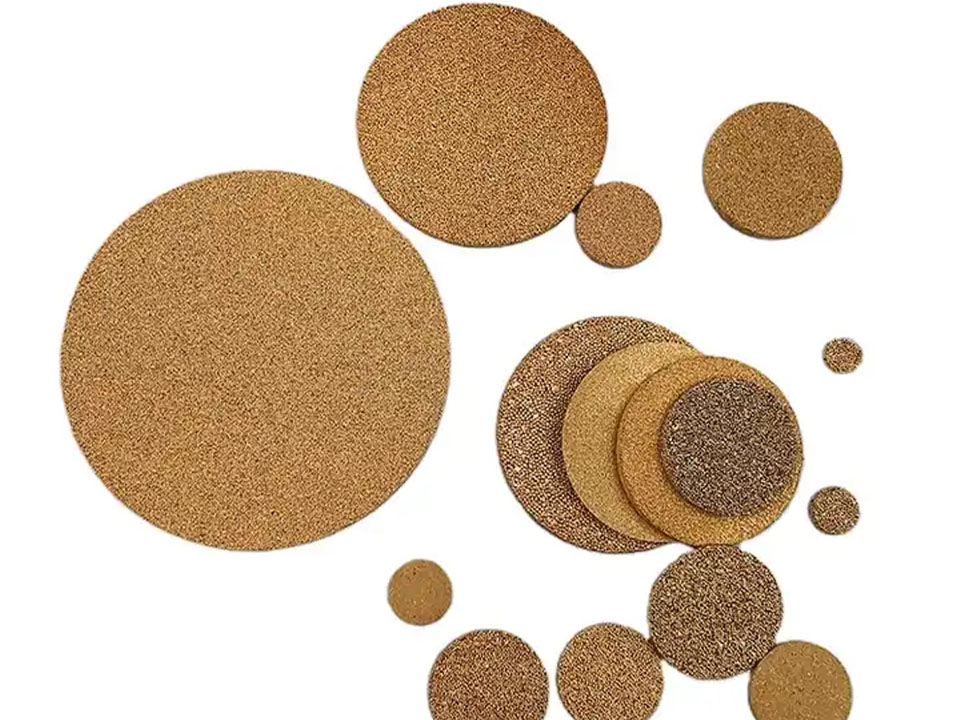
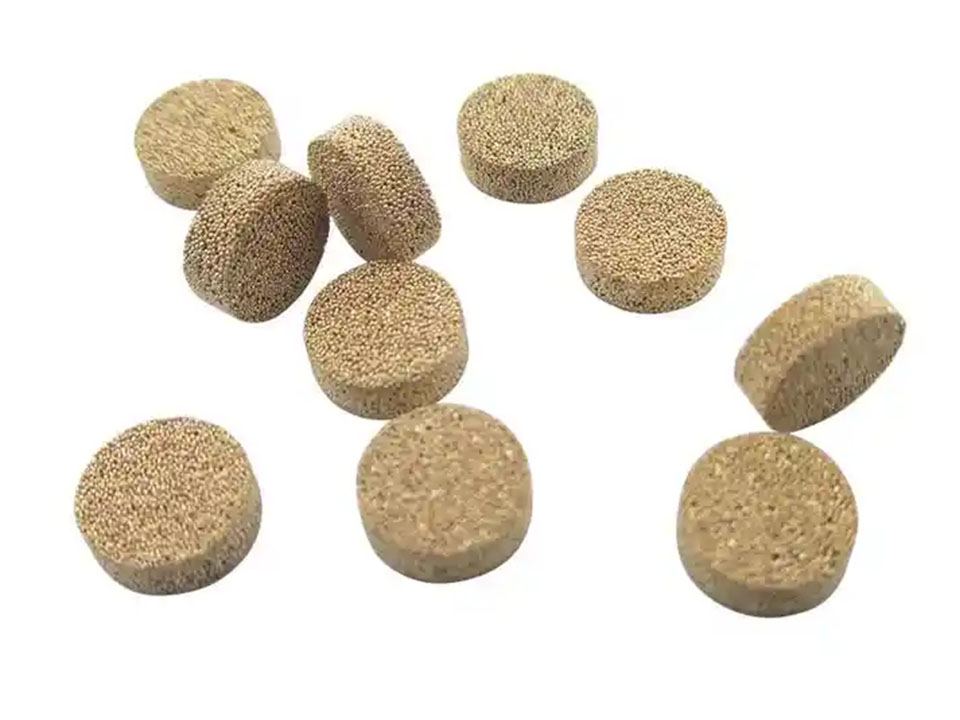
No holes are drilled afterward. There’s no woven wire hiding inside, and the pores aren’t cast into the part like tiny engineered tunnels. Instead, the pore network appears because thousands of bronze particles are packed together and heated until the contact points bond—while the gaps between those particles remain open.
Simple, right?
Not quite.
A typical industrial route can involve spherical Cu89Sn11 bronze powder, a graphite mold, controlled vibration, a continuous furnace whose hottest zone sits near 820°C, and a reducing hydrogen atmosphere used to keep oxidation under control. The powder particles bond at their contact points, but the entire charge doesn’t collapse into a solid puddle of bronze. That distinction is the whole process. (sciencedirect.com)
And here’s where buyers often get caught out: the outside dimensions can look perfect while the internal pore network is wrong.
I frankly believe this is why bronze filters should never be purchased on appearance and micron wording alone. A factory isn’t merely forming a small metal tube; it’s building a three-dimensional flow path inside that tube, one powder contact at a time.
The short manufacturing answer
A sintered bronze filter is made by selecting and classifying bronze powder, loading that powder into a heat-resistant mold, vibrating or settling it to establish repeatable packing, heating it under a controlled furnace atmosphere, cooling and demolding the bonded porous body, and then checking its dimensions, pore behavior, permeability, and mechanical integrity.
For many cylindrical bronze elements, the route is known as the gravity sintering process, loose-powder sintering, or pressureless sintering.
But the name is a little misleading.
“Gravity” doesn’t mean somebody tips a sack of powder into a mold, gives it a quick shake, and hopes for the best. Powder feed rate, particle distribution, vibration energy, mold geometry, filling depth, core alignment, furnace loading, and atmosphere control all affect the finished structure.
Unlike conventional pressed powder metallurgy parts, the powder may not be heavily compacted before entering the furnace. Gravity and vibration arrange the particles. Heat forms the metallic necks.
That changes porosity—a lot.
A published comparison of porous bronze samples reported apparent porosity of around 50–60% for loose-sintered material, versus roughly 20–30% for compacted samples. The same research found that larger particles tended to increase apparent porosity, while more compaction pressure, longer sintering time, or higher sintering temperature generally pushed compacted material toward lower porosity. (sciencedirect.com)
So, yes, the furnace matters.
But it isn’t everything.
Step 1: Specify the bronze powder before designing the filter
Powder quality wins.
That’s a blunt statement, but I stand by it. Every working passage inside a sintered bronze filter originates from the powder’s chemistry, size, shape, oxide condition, surface texture, and ability to settle consistently inside the tooling.
What happens when those variables drift?
Usually nothing visible. That’s the problem.
The filter may still come out round. Its threads may still fit. The surface may even look clean and evenly colored. Yet its airflow, bubble point, pressure loss, retention behavior, or mechanical strength can move outside the expected range.
For gravity-sintered parts, factories commonly use spherical or near-spherical prealloyed bronze powder. Spherical particles flow more freely into narrow cavities, settle around internal cores with less bridging, and create more predictable interconnected gaps than badly shaped powder.
One established industrial example uses Cu89Sn11—approximately 89% copper and 11% tin. It’s a useful reference composition for loose-powder bronze sintering, but it isn’t a universal recipe that every factory should copy without thought. Alloy selection still has to match the fluid, temperature, corrosion conditions, furnace profile, regulatory requirements, and price target. (sciencedirect.com)
A proper powder specification should cover:
Alloy composition and allowable chemistry variation
Particle-size distribution rather than one nominal mesh number
Particle morphology and sphericity
Apparent density
Flowability
Oxygen and surface-oxide condition
Moisture and contamination control
Lot traceability
Here’s the ugly truth: particle-size wording is regularly abused in filter quotations.
A supplier might offer a “40-micron bronze filter,” but what does 40 μm actually describe? The bronze powder fraction? Mean pore size? Maximum pore opening? Nominal retention? Absolute retention? A test result from air, oil, or water?
Those aren’t synonyms.
And they definitely aren’t interchangeable specifications.
الـ best bronze powder for sintered filters is therefore not simply the finest grade available. It’s the powder that repeatedly produces the required permeability, filtration behavior, dimensions, strength, and service compatibility after the full furnace cycle.
Finer isn’t always better.
Step 2: Prepare the mold and integrated hardware
Then comes the mold.
Graphite is widely associated with loose-powder bronze sintering because it can tolerate high temperatures and, when correctly selected, helps reduce unwanted reactions or sticking between the mold and the sintered bronze body.
Tubes are common. So are discs, cups, bushings, silencers, cones, plugs, and other porous shapes—provided the cavity can be filled evenly and the finished component can actually be removed after sintering. (sciencedirect.com)
But mold design isn’t just a question of copying the customer’s outside diameter.
A competent tooling review should consider:
Powder access into thin or deep cavities
Uniform filling around cores
Local differences in packing density
Furnace expansion and contraction
Demolding direction
Surface condition
Required wall thickness
Attachment of threads, flanges, sockets, or inserts
Consider a long, narrow bronze tube with a thin porous wall. The outside dimension may be easy enough to define, but the powder must also flow evenly around the entire core without bridging, segregating, or leaving low-density patches near the bottom of the mold.
That’s the fiddly part.
Hardware can sometimes be placed in the tooling before furnace processing, allowing the porous bronze body to form a sintered connection with a socket, flange, thread, bolt, or similar insert. It can eliminate a later joining operation—but only when the powder, insert alloy, atmosphere, surface condition, and connection geometry behave properly together. (sciencedirect.com)
For unusual connections, replacement filters, or customer-owned housings, a custom OEM/ODM filter development process should start with the actual interface and duty conditions.
Not a catalog photograph.
Step 3: Fill and vibrate the powder
Powder goes in. Carefully.
Gravity carries the particles into the mold, while controlled vibration encourages them to settle, rearrange, and occupy the cavity more consistently. The aim isn’t maximum density; the aim is repeatable density without rogue voids, bridging, or segregation.
There’s a difference.
Too little vibration can leave loose zones and abnormally large passages. Too much vibration can separate a broad powder blend, allowing fine particles to migrate between coarse ones and pack certain regions more tightly than others.
That local density shift can choke flow.
From the outside? Invisible.
This is one reason I’m skeptical when a supplier says its gravity sintering process is “fully automatic” but can’t describe how filling weight, vibration time, mold position, or powder reuse is controlled. Automation doesn’t fix a poor process. It only repeats it faster.
The pressureless sequence described by Industrial Specialties Manufacturing follows the expected route: bronze powder is poured into the mold, vibration helps reduce unintended voids, and the loaded mold enters a furnace cycle below the alloy’s full melting temperature. As the powder heats, metallic necks form between particles that are touching. (industrialspec.com)
It sounds tidy on paper.
Production rarely is.
Humidity changes. Powder lots behave differently. Tooling wears. Operators refill hoppers. Reclaimed powder gets mixed back in. Cores shift slightly. Furnace belts carry different loading densities from one run to another.
A serious manufacturer plans for that mess.
Step 4: Run the bronze powder sintering cycle
Now the heat.
The filled molds move into a controlled-atmosphere furnace. In one established process description, Cu89Sn11 powder in graphite tooling passes through a continuous furnace with a hottest zone near 820°C, while a reducing hydrogen atmosphere helps prevent excessive oxidation and supports the formation of stable sintering necks. (sciencedirect.com)
But quoting “820°C” as though it were a universal magic number is sloppy engineering.
I’ll be direct: a furnace setpoint copied from an article doesn’t become a validated production recipe simply because the alloy name looks similar. Powder size, oxide loading, part thickness, mold mass, belt speed, atmosphere dew point, thermocouple position, furnace geometry, and required performance all shift the real thermal window.
The cycle normally passes through several stages:
Preheating: Moisture and volatile residue are driven off while the powder and tooling warm more gradually.
Heating: The component approaches its intended sintering range without severe thermal gradients.
Sintering hold: Diffusion strengthens the contact points between neighboring particles.
Controlled cooling: The bonded part cools while oxidation, cracking, and distortion are limited.
Inside the powder bed, the particles don’t vanish.
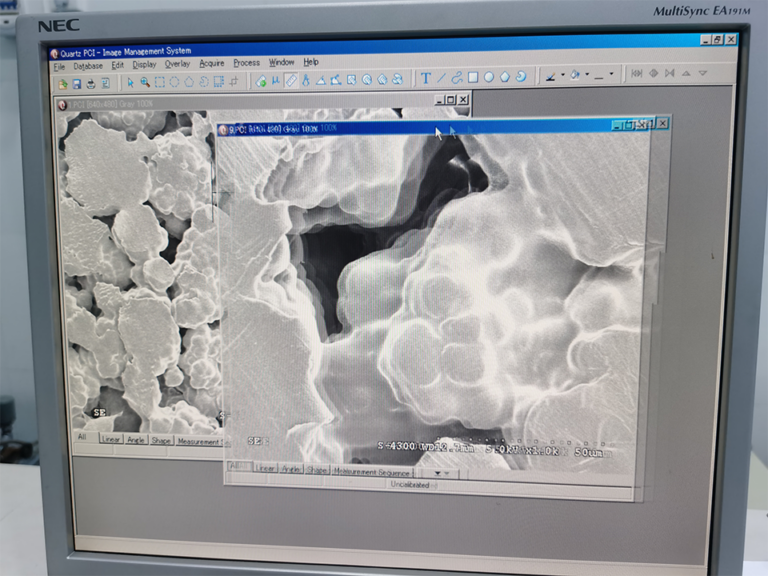
Their contact points grow together. Their surfaces remain partly recognizable. Meanwhile, the unoccupied spaces between them form a crooked, interconnected network through which gas or liquid can later travel.
That’s the trick.
Strength is gained at the contacts, but permeability survives in the gaps. Push the furnace cycle too little and the filter may be weak or shed particles. Push it too far and pore throats may tighten, permeability may fall, and dimensions may begin to drift.
The operator is walking a line.
What happens between bronze particles?
At sintering temperature, atomic diffusion takes place across the contact boundaries between adjacent bronze particles. Small bridges—called sintering necks—begin to grow wherever the particles touch.
More neck growth generally means more mechanical stability.
But there’s a catch.
The manufacturer doesn’t want a solid bronze slug. It wants enough bonding to survive pressure, installation, vibration, transport, cleaning, and handling, while retaining enough open, connected porosity to pass the required flow.
Those targets fight each other.
The 2024 Powder Technology study on reconstructed porous bronze structures modeled powder compression, sintering, three-dimensional pore morphology, permeability, and internal flow. The value of that work isn’t that digital simulation replaces a production test bench—it doesn’t—but that it shows how particle geometry, spatial randomness, pore connectivity, and permeability are tied together.
One structure. Many variables.
And this is precisely why a single micron number tells only a thin slice of the story.
Step 5: Cool, demold, and inspect the porous body
Cooling looks passive.
ليس كذلك.
The mold, bronze body, inserts, and furnace atmosphere are still interacting while temperature falls. Cool too aggressively and the part may crack, distort, or develop unwanted surface conditions. Expose a hot porous body to the wrong atmosphere and oxidation can reach deep into a structure with enormous internal surface area.
After cooling, the bronze component is removed from the mold.
Loose-powder bronze sintering can show relatively small shrinkage compared with powder processes designed to approach full density, which may make dimensional control and demolding easier. Still, “relatively small” doesn’t mean “ignore it.” Each design needs trial data, realistic tolerances, and repeatable furnace loading. (sciencedirect.com)
At this stage, inspection should look for:
Cracks
Chipped edges
Incomplete sintering
Powder shedding
Distortion
Surface oxidation
Blocked areas
Abnormal color
Insert misalignment
Dimensional nonconformance
A darker bronze surface isn’t automatically defective. A shiny one isn’t automatically good.
Color can shift because of powder condition, deoxidation, furnace atmosphere, cleaning, handling, oxide thickness, or a later finishing step. Buyers who judge porous metal filters by cosmetic brightness are looking at the easiest characteristic—and probably the least useful one.
Flow data is harder to fake.
Step 6: Machine carefully—or destroy the pores
Threads may still be needed. So might shoulders, grooves, sealing faces, bores, or close-tolerance mounting surfaces.
This is where a decent sintered part can be quietly ruined.
Porous bronze doesn’t cut exactly like a conventional solid bronze bar. Tool pressure can smear soft material across exposed pore openings, collapse pore edges, drag metal into the cavities, and pack chips into the surface.
Dimensions pass.
Permeability doesn’t.
The 2024 Precision Engineering study on machining porous bronze used monocrystalline diamond tools and extensive surface-image analysis to examine how machining parameters altered pore morphology. The researchers found that the machining conditions measurably affected surface-pore characteristics, with cutting depth strongly influencing how material was removed.
That shouldn’t surprise anyone who has handled porous metal.
Yet it does.
A smooth, polished-looking filter surface may actually be worse if the finishing process has folded bronze over the pore mouths. For this reason, sealing lands and connection areas should be machined where necessary, but functional filtration surfaces shouldn’t be aggressively beautified merely for photographs.
Pretty can be blocked.
Gravity-sintered versus compacted bronze filters
Manufacturing factor
Gravity or loose-powder sintering
Compaction followed by sintering
Powder forming method
Powder settles under gravity and controlled vibration
Powder is mechanically pressed before furnace processing
Green-part handling
Powder commonly remains supported by the mold
Pressed green compact can often be handled separately
Typical structural goal
High interconnected porosity and permeability
Higher density, strength, or dimensional consolidation
Reported porosity example
Approximately 50–60% in one porous-bronze study
Approximately 20–30% in the same study
Powder preference
Frequently spherical, flowable powder
Irregular powder may improve mechanical interlocking
Shrinkage behavior
Often relatively limited in established bronze routes
Depends heavily on pressure, lubricant, density, and furnace cycle
Common filter advantage
Open flow paths and controllable permeability
Greater structural density where higher strength is required
Main production risk
Nonuniform filling or local powder segregation
Density gradients, pressing defects, and pore closure
Those numbers aren’t promises.
They came from specific research conditions, and commercial filters made with other alloys, powder distributions, geometries, pressures, or furnace cycles may behave differently. Still, the comparison exposes the basic tradeoff: loose sintering tends to preserve more open space, while pressing tends to consolidate the powder.
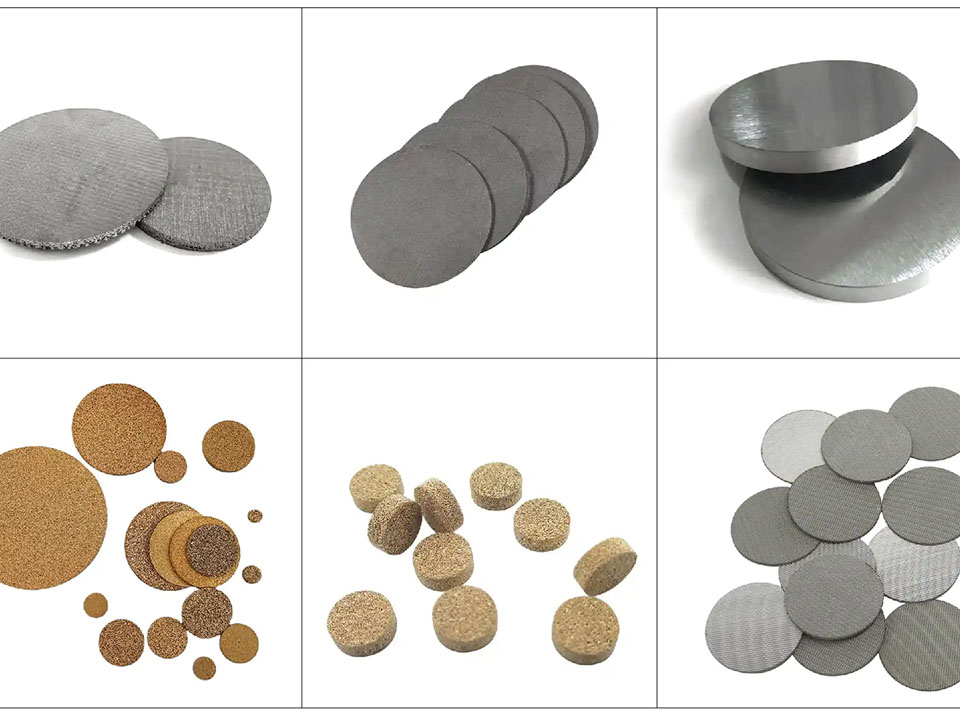
Buyers choosing between porous metal designs should also compare خراطيش الترشيح المعدنية الملبدة made from powder, metal mesh, fiber felt, or pleated structures. They’re all “sintered metal,” but they don’t flow, retain particles, handle pressure, or clean in the same way.
The media architecture changes everything.
How manufacturers control the pore structure
A porous bronze filter doesn’t contain thousands of identical, laser-perfect holes.
It contains winding passages.
Some openings narrow into pore throats. Others widen into larger cavities. Many turn, split, reconnect, or terminate inside the material. Fluid doesn’t simply cross a flat screen—it works its way through a three-dimensional maze.
Manufacturers influence that maze through powder and process control.
Control variable
Likely effect when increased or changed
Possible production consequence
Bronze particle size
Larger particles generally create larger voids
Higher permeability but coarser retention
Fine-particle content
Fines fill spaces between larger particles
Lower permeability and smaller pore throats
Size-distribution width
Broad distributions pack more densely
Reduced open porosity or local segregation
Vibration intensity
Increases particle rearrangement
Better settling, but excessive vibration may segregate powder
Sintering temperature
Promotes stronger neck growth
Excess exposure may reduce porosity
Sintering time
Extends diffusion and bonding
Greater strength, possible pore contraction
Atmosphere quality
Controls oxidation and surface chemistry
Poor control can weaken bonding or contaminate surfaces
Wall thickness
Increases flow-path length
Higher pressure drop at the same pore structure
Post-machining
Alters exposed pore edges
Smearing, blockage, or reduced surface permeability
Notice how many knobs exist.
Particle size gets most of the attention because it’s easy to print on a certificate. Yet wall thickness, vibration, fine-particle contamination, atmosphere stability, and surface machining can all change the pressure drop or effective retention.
This is why professional sintered metal filter manufacturing should be managed as a repeatable powder-metallurgy process—not treated as basic furnace subcontracting.
The difference shows up later.
Usually in the customer’s machine.
What should be tested after porous bronze filter manufacturing?
Some factories check the dimensions, glance at the color, and box the parts.
That may be enough for decorative hardware. It isn’t enough for a functional porous component.
Depending on the application, a sensible control plan may include:
Alloy or material verification
Powder-lot traceability
Dimensional inspection
Weight and apparent-density comparison
Airflow or liquid-flow testing
Differential-pressure testing
Maximum-pore or bubble-point evaluation
Filtration-efficiency testing
Mechanical-strength testing
Pressure or leak testing
Cleanliness inspection
Particle-shedding evaluation
Corrosion or compatibility testing
Joint-strength testing for inserted fittings
Here’s the ugly truth: “5-micron filter” still isn’t a usable engineering specification.
Five microns at what efficiency?
Measured using which particles? Under what flow? In air, water, hydraulic oil, diesel, or another fluid? At what viscosity and temperature? Does the number describe nominal retention, absolute retention, a maximum pore, or a powder fraction?
Without a defined test method, two manufacturers can print the same micron grade on two boxes while shipping filters that behave nothing alike.
I don’t trust naked micron numbers.
Neither should you.
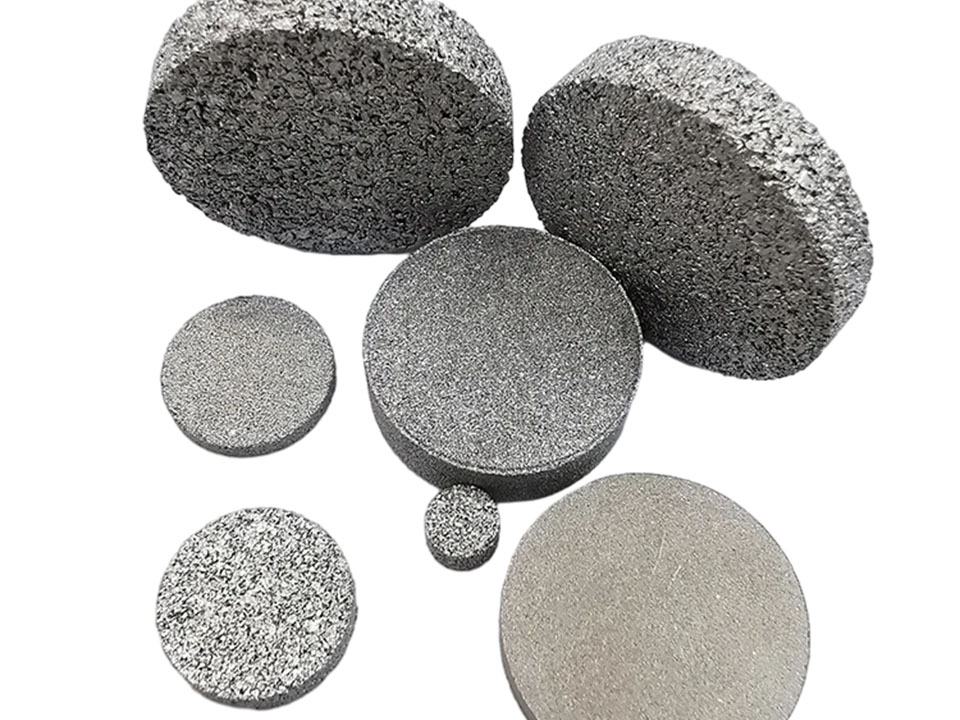
For projects involving different alloys or filtration structures, the broader industrial sintered filter cartridge range helps separate porous bronze powder components from sintered plastic, stainless steel, titanium, and other filter media.
Same word—“sintered.”
Different engineering.
What recent evidence tells us about process control
The academic papers become useful when they’re read as production warnings rather than decorative citations.
Take the July 2024 Powder Technology study. Researchers reconstructed a three-dimensional porous bronze structure by simulating stages of the powder-metallurgy process, then evaluated pore morphology and permeability. The takeaway isn’t that a computer model can approve a shipment. It can’t. The useful point is that permeability develops from the whole interconnected structure—not from one attractive surface image. (sciencedirect.com)
Then there’s the August 2024 Precision Engineering research.
It showed that machining conditions alter porous bronze morphology. A filter can therefore be correctly sintered, correctly sized, and still leave the machining station with damaged surface pores because the tool, depth of cut, or material-removal mechanism was wrong. (sciencedirect.com)
That’s uncomfortable.
But useful.
الـ 2023 MPIF Design Excellence Awards also documented a binder-jetted 316L fluid exchanger printed approximately 20% oversized to compensate for shrinkage during sintering.
No, that part wasn’t a gravity-sintered bronze filter.
That’s precisely why I’ve kept the example. It shows how wildly shrinkage behavior can differ between powder routes. Binder jetting, pressureless bronze sintering, metal injection molding, and conventional press-and-sinter processing shouldn’t share one borrowed shrinkage assumption.
Process names matter.
So does the metal supply chain. Reuters reported that worldwide copper mine output reached about 22.4 million metric tons in 2023, while refined copper use reached approximately 26.5 million tons. Those totals don’t calculate the price of one bronze filter, obviously, but they show that bronze powder sits downstream of a huge copper market affected by mine output, smelting capacity, electricity costs, regional demand, speculation, and alloying-material availability. (reuters.com)
Raw powder pricing moves.
Quotes eventually follow.
What separates a reliable bronze filter from a cheap one?
Not the color.
Not the weight alone.
And not a sales rep saying, “Same quality.”
A reliable sintered bronze filter comes from controlled powder chemistry, stable particle sizing, consistent mold filling, documented vibration settings, validated furnace recipes, monitored atmosphere conditions, restrained post-machining, lot traceability, and tests that actually match the application.
A weak supplier sells geometry.
A strong supplier sells predictable flow and retention.
That’s my view, and I think procurement teams should be far more demanding here. A bronze filter is often a low-cost component installed inside much more expensive equipment. Saving a few cents on the porous element makes little sense when inconsistent flow, debris release, or premature blockage can stop the machine around it.
Before approving production, ask for:
The bronze alloy designation or chemistry range
Powder-size distribution controls
Whether the part is gravity-sintered or compacted
The definition of the quoted micron rating
Flow or pressure-drop data
Test-fluid and test-condition details
Maximum operating temperature and differential pressure
Chemical-compatibility limitations
Cleaning and regeneration guidance
Inspection records and lot traceability
Prototype or first-article testing
Dimensional tolerances after sintering and machining
And listen closely to the answers.
A credible industrial filtration factory should be able to explain how its powder is received, classified, stored, loaded, sintered, cooled, machined, cleaned, and tested. “We have many years of experience” isn’t an inspection plan.
It’s marketing copy.
الأسئلة الشائعة
What is a sintered bronze filter?
A sintered bronze filter is a rigid porous metal component made by heating controlled bronze powder until neighboring particles bond without turning the entire charge into solid metal, leaving interconnected passages that can trap contaminants, distribute flow, damp pressure, or separate aerosols from a moving gas or liquid stream.
Those internal passages are created between powder particles rather than drilled through the finished part. Final performance depends on bronze chemistry, powder distribution, particle shape, packing density, wall thickness, sintering conditions, and any machining performed afterward.
Typical uses include pneumatic silencers, hydraulic systems, lubricating equipment, fuel systems, gas distribution, aerosol separation, pressure damping, and protection of sensitive downstream equipment. (sciencedirect.com)
What is the gravity sintering process?
Gravity sintering is a pressureless powder-metallurgy process in which flowable bronze powder is loaded into a heat-resistant mold, settled through gravity and controlled vibration, and heated under a managed atmosphere until metallic necks bond adjacent particles while preserving the connected voids needed for permeability and filtration.
It’s also called loose-powder sintering or pressureless sintering.
Unlike conventional pressing, the process doesn’t rely on high compaction pressure to form a dense green part. The powder usually stays supported by the mold until furnace bonding gives the component enough strength to be handled.
Loose doesn’t mean uncontrolled.
What is the best bronze powder for sintered filters?
The best bronze powder for sintered filters is a prealloyed, consistently classified powder whose chemistry, morphology, apparent density, surface condition, and particle-size distribution repeatedly produce the required pore structure, permeability, mechanical stability, dimensions, and filtration behavior after sintering under validated production conditions.
Spherical particles are commonly selected for gravity sintering because they flow and pack more predictably. Cu89Sn11 is one documented industrial example, but it shouldn’t be treated as the only acceptable alloy for every fluid, temperature, pressure, corrosion environment, or regulatory requirement. (sciencedirect.com)
The application decides.
ليس الكتيب.
How is a sintered bronze filter micron rating controlled?
A sintered bronze filter’s micron rating is controlled by managing bronze particle-size distribution, particle packing, fine-powder content, vibration, wall thickness, furnace temperature, sintering time, and the interconnected pore throats formed between particles, followed by testing under clearly defined conditions rather than estimating performance from powder mesh alone.
The rating should state whether it’s nominal or absolute and identify the required efficiency, test fluid, challenge particles, flow rate, temperature, and differential pressure.
Without that context, the micron figure is incomplete.
Sometimes nearly meaningless.
Is gravity sintering better than compacting bronze powder?
Gravity sintering isn’t automatically better than powder compaction; it is generally favored when high interconnected porosity and permeability are the main requirements, while compaction is more appropriate when the component needs greater consolidation, higher density, stronger structural behavior, or characteristics that can’t be obtained from a loose-powder structure.
One comparative study reported apparent porosity of approximately 50–60% in loose-sintered bronze and roughly 20–30% in compacted samples. Those figures illustrate the difference between the routes, but they aren’t guaranteed specifications for every commercial filter. (sciencedirect.com)
Better depends on the job.
Always.
Can sintered bronze filters be cleaned and reused?
A sintered bronze filter can often be cleaned and reused when its alloy, contaminant type, pore structure, attached hardware, and operating history are compatible with the cleaning method, but reuse should be approved only after flow, pressure drop, cleanliness, pore condition, and mechanical integrity have been checked against acceptance limits.
Possible cleaning routes include reverse flow, compatible solvents, ultrasonic cleaning, or carefully controlled thermal processing.
But don’t get reckless.
Aggressive brushing can deform the surface. Unsuitable acids can attack copper or tin. Excessive heating can change the pore structure or oxidize the part. High-pressure jets may damage thin walls or weakly bonded areas.
Cleanable isn’t the same as indestructible.
Request a custom sintered bronze filter
Send the outside diameter, inside diameter, overall length, porous-wall thickness, connection details, filtration requirement, target flow rate, fluid or gas composition, operating temperature, working pressure, differential pressure, cleaning method, annual volume, and any drawing or physical sample available.
Don’t begin with “I need 10 microns.”
Begin with the system.
A properly engineered sintered bronze filter has to balance particle retention, permeability, wall thickness, strength, corrosion compatibility, pressure loss, mounting design, cleanability, dimensional tolerance, and production repeatability. Change one variable and another usually moves with it.
That’s powder metallurgy.
For custom bronze elements, unusual fittings, replacement components, new pore structures, or application-specific prototypes, request an engineering review through our OEM/ODM filtration manufacturing service.